
Contact ADS UK on 0203 442 0607 or click here
Contact ADS UK on 0203 442 0607 or click here
Stuart Crisp, UK Manager, Advanced Drainage Systems, looks at the hydraulic requirements of Sustainable Drainage Systems (SuDS) in the context of the recently revised National Planning Policy Framework.
Surface water drainage has traditionally been thought of as a flood problem. The same development may have to cope with intense rainfall one day and a prolonged dry spell the next. The designer therefore needs to consider what happens to rainfall before it becomes runoff, as well as what happens when the drainage system is tested by a major storm.
On a greenfield site, the first 5mm of rainfall would not typically become surface runoff: it infiltrates, evaporates or is taken up by vegetation. But in an urban environment, as much as 95% of rainfall can become runoff.
The starting point for hydraulic design is therefore to get as close as practicable to the greenfield response. That means storing water and controlling the discharge rather than simply moving it away. Attenuation remains central to SuDS design.
The National Standards for Sustainable Drainage Systems broaden that approach. The guidelines apply to major developments in England to manage surface water, reduce pollution, and lower flood risk. Though they are currently enforced via planning policy rather than a binding statutory approval regime (as Schedule 3 of the Flood and Water Management Act 2010 remains unenacted) and updated planning frameworks mandate their use.
They describe rainfall and runoff as a resource and set a hierarchy for where runoff should go: first to non-potable use, then infiltration to ground, followed by an above-ground water body, a surface water sewer and, as the lowest priority, a combined sewer. They also require the first 5mm of rainfall from most events to be managed so that it does not become runoff leaving the site. Rainwater harvesting can provide one route to meeting this requirement.
This has practical implications. Hydraulic design is not just a question of calculating attenuation volume for an extreme event. Everyday rainfall, infiltration, re-use, treatment and exceedance are part of the system. Conveyance should follow natural drainage routes where possible, with exceedance flows following the same logic.
The calculation itself remains an approximation. CIRIA C753 The SuDS Manual and BS EN 16933-2 provide the basis for the design, and software such as InfoDrainage, MicroDrainage, Flow and Site3D is now routine. But software can conceal the assumptions and coefficients behind a result. Anthony McCloy’s warning in the SUSDRAIN factsheet Assessing attenuation storage volumes for SuDS (2014), remains worth remembering: modelling should be used with professional judgement, not instead of it.
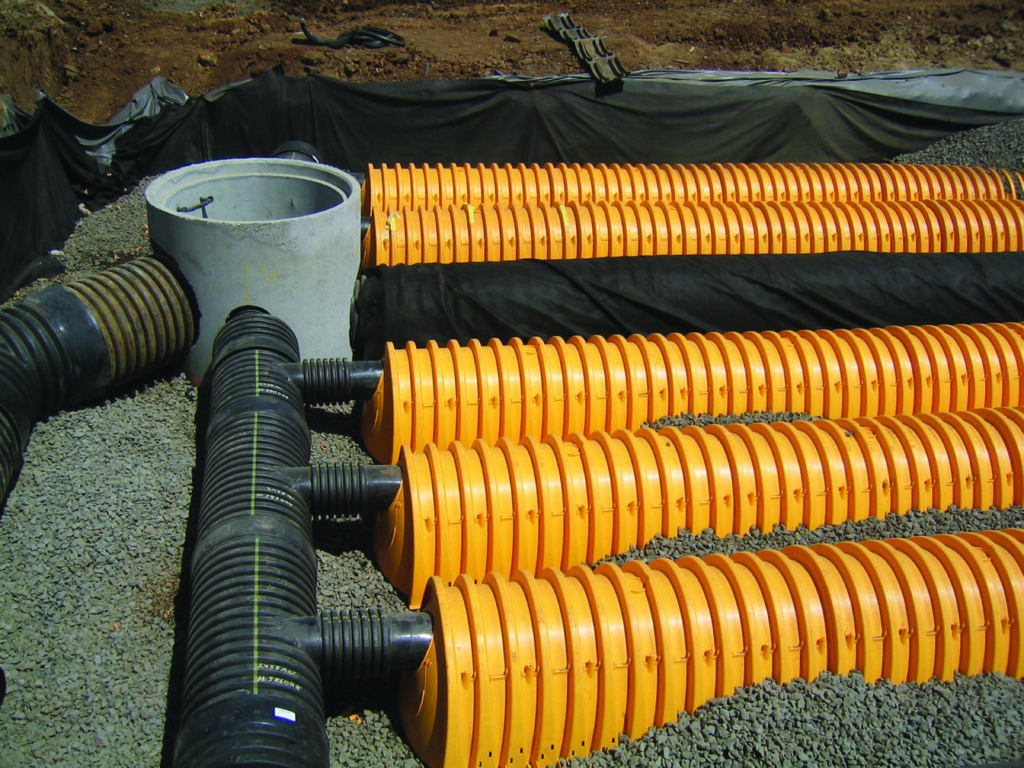
There is a choice of storage. Green infrastructure, such as ponds, detention basins and swales can work well where land is available and ground conditions are suitable. Below ground, grey infrastructure, such as permeable paving, geocellular crates, large-diameter pipes and arch-shaped chambers – such as StormTech – provide alternatives where constraints limit the use of green infrastructure, such as available space and high pollution loading. Green and grey systems need not be mutually exclusive and a combination may make more sense.
Whichever approach is chosen, the design needs to survive contact with the actual asset deployed in the development. Sediment reduces storage and can restrict flows. Paving joints clog. Ponds need desilting. Underground systems need to be accessible for inspection and maintenance, not simply buried and forgotten. Geocellular systems, especially, that are difficult to clean may need additional storage allowance to offset sediment accumulation. Product substitution during procurement can create a risk where the replacement has not been checked against the original design brief and compliance with the relevant standards and certification.
The National SuDS Standards make this lifecycle issue explicit. Standard 7 requires the drainage system to be designed for construction, operation, maintenance and decommissioning, with a management and maintenance plan and consideration of potential failure scenarios. The National Planning Policy Framework published on August 17th now reinforces the point. Policy F8 requires development proposals that could affect drainage to incorporate SuDS proportionate to their scale, designed in accordance with the National SuDS Standards, with maintenance arrangements for the anticipated lifetime of the development. Major developments must also take account of Lead Local Flood Authority advice.
For developers, designers, contractors and asset owners, the change is less about choosing a particular type of SuDS and more about getting the hydraulic design right from the outset. A system that manages a cloudburst but performs poorly in ordinary rainfall is not a complete solution. Nor is one that works on paper but becomes inaccessible, silted up or difficult to maintain. The test is whether it can continue to do its job over the lifetime of the development.
Water Magazine November 2026
© Copyright 2026. All rights reserved | Privacy Policy