
Contact ADS UK on 0203 442 0607 or click here
Contact ADS UK on 0203 442 0607 or click here

Buyer Beware
Standards, certification, compliance and approvals all exist to provide reassurance to the specifier, purchaser and asset owner that the product will perform as expected. It should be clearly noted, however, that for construction products, only a Declaration of Performance (DoP) and a CE Mark provide legally enforceable protection against rogue manufacturers.
Standards, certification, compliance and approvals are common terms in manufacturer’s literature, detailing the performance of their products.
Standards are the rules and guidelines that prove quality of construction. They are normally developed by official bodies such as the International Organisation for Standardisation (ISO).
Certification is independent confirmation that the product meets the standard that the manufacturer claims. Certification is normally conducted by 3rd party auditing bodies such as the British Board of Agrément (BBA) who provide the manufacturers with appropriate certification such as UK Conformity Assessed (UKCA).
Compliance is the ongoing commitment that manufacturers make to ensure that their certified products continue to meet the agreed standards. This compliance is normally audited by specialist external consultants (e.g. The Building Safety Regulator) listed as an UK Market Conformity Assessment body.
Approvals are the formal authorisation or permission granted by an authority to proceed with a project or plan.
Approvals can be dependent on compliance, certification, and meeting required standards.
The Standard sets what quality looks like, the Certification is the official recognition of achievement. Compliance is the audited commitment to continue reaching that Standard and Approvals are the permissions to proceed, all the above requirements having been met.
Stormwater management assets, such as SuDS attenuation and stormwater treatment systems must do more than safeguard water quality and provide storage capacity. Long-term performance, safety, and compliance are critical to ensure systems remain fit for purpose years after installation.
Standards are integral to this process. The British Standards Institution (BSI) states that Standards provide trusted frameworks for quality, safety, and efficiency, acting as benchmarks that boost trust, open global markets, drive innovation, reduce waste, and help meet sustainability goals.
Full compliance with the relevant standard(s) is essential. Some manufacturers may select specific parts of a standard and claim compliance, misleading users into thinking that a product meets the entire standard. Manufacturers’ claims therefore, must be supported by credible, independent audits that are transparent in detailing the full scope of the assessment.
Due diligence insists that anyone involved in the design, installation, or adoption of SuDS systems ensures that the specified products are compliant with relevant industry standards, are certified to pertinent industry specifications and meet applicable certifications and approvals. This provides the reassurance that the products are fit for purpose and will perform as expected.
Voluntary certification versus legal protection
Under the guidance of the European Construction Products Regulation, only a Declaration of Performance (DoP) and CE Mark provide legally enforceable protection against performance failures.
However, it is not mandatory. If manufacturers wish to demonstrate that their products have been independently tested and verified to meet recognised performance standards, they have 3 options.
One option is voluntary certification as detailed below. The second and third options lead to the award of a CE mark. Only the CE mark and accompanying DoP offer legal protection.
ADS StormTech is the only proprietary SuDS attenuation and treatment system in the UK that has been evaluated and can bear the CE mark.
Voluntary Certification
Manufacturers may provide an independent evaluation, detailing the methods and criteria for assessing their product’s performance, as set out in a relevant national Standard. An independent Technical Assessment Body (TAB) such as BBA or DIBt must then assess the product’s performance. The European Plastic Pipes and Fittings Association (TEPPFA) state that having completed this process, it is allowable for products to be sold in Europe.
The hEN standard
The harmonised European Standard (hEN) is different to a European Norm (EN). hENs cover many different construction products across Europe, but if there is no hEN, manufacturers are unable to issue assessments using this approach and will not be able to issue a CE mark.
The SPADE Process
If a hEN does not exist for the product, as in the case of arch shaped drainage systems such as Stormtech, manufacturers wishing to demonstrate that their product is independently tested and verified to recognised performance standards, and to offer legal protection against performance failures by applying the CE mark, must follow the SPADE Process.
1. SPecification
Manufacturers must provide a European Assessment Document (EAD) which defines the methods and criteria for assessing a specific product’s performance when no hEN exists. These must be developed in conjunction with the European Organisation for Technical Assessment (EOTA).
2. Assessment
Manufacturers must then provide a European Technical Assessment (ETA) conducted by an independent Technical Assessment Body (TAB) such as BBA or DIBt (see below) which provides third-party evaluation of a product’s performance based on the EAD.
3. DEclaration of Performance
Manufacturers must then issue a Declaration of Performance (DoP), a legally binding document that aligns the product’s performance with the ETA.
The product may then display a CE mark
ADS StormTech is the only proprietary SuDS attenuation and treatment system in the UK that can display the CE Mark. It must be understood that the EAD and ETA are voluntary technical assessments. Only a DoP and CE Mark give legal responsibility for performance.

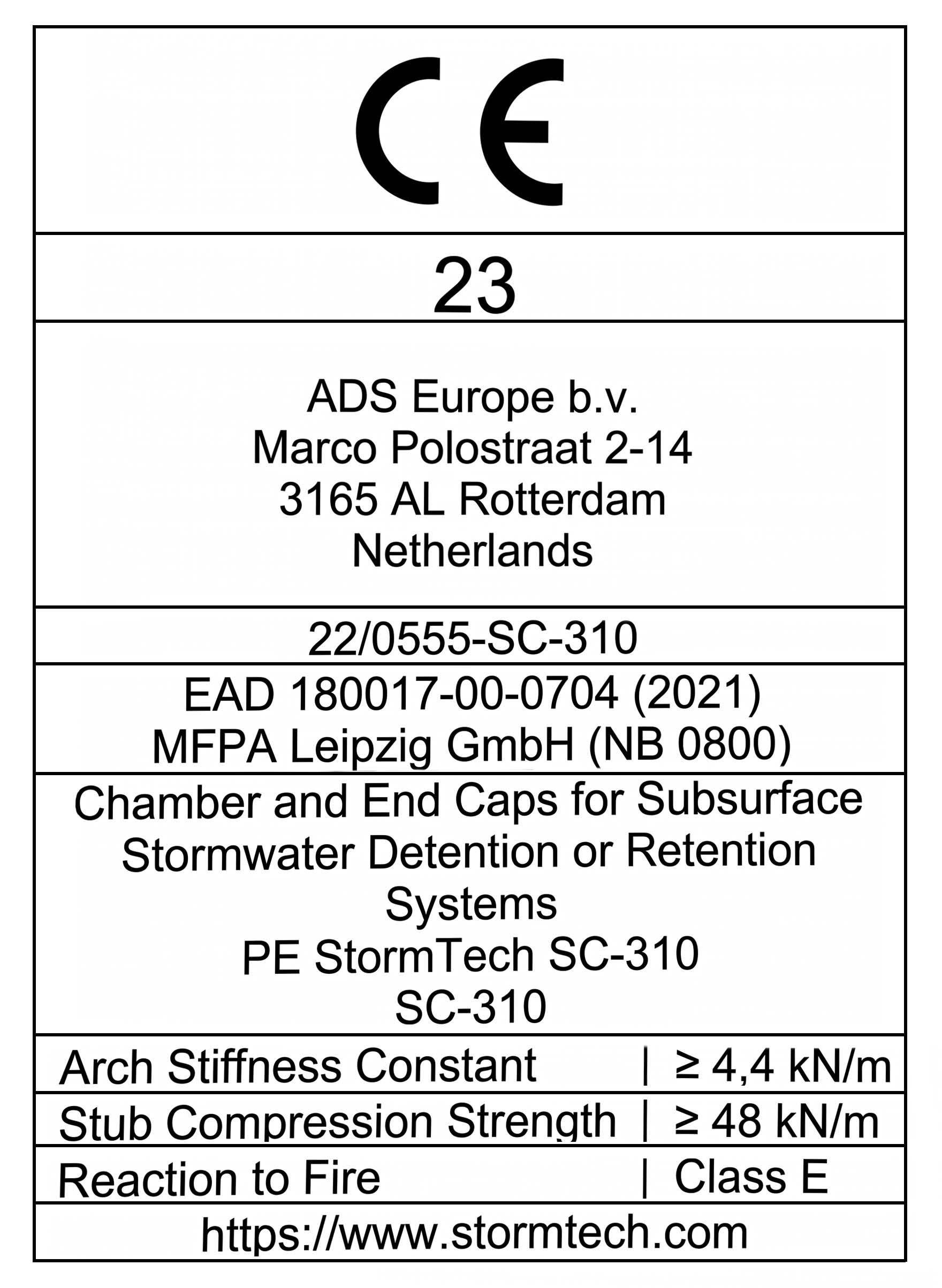
| Component | Role | Developed/Issued By | Key Function |
|---|---|---|---|
|
EAD |
Technical Specification |
EOTA/TABs (via EOTA) |
Defines assessment methods. |
|
ETA |
Technical Assessment |
TAB (e.g., DIBt, BBA) |
Validates product performance. |
|
DoP |
Declaration |
Manufacturer |
Takes legal responsibility for performance. |
|
CE Mark |
Legal Label |
Manufacturer |
Enables free, legal market access. |
Certification is the third-party proof that an organisation, product, or person meets Regulatory rules and Standards, acting like a quality stamp or diploma.
Drainage devices for highways must meet National Highways’ Design Manual for Roads and Bridges (DMRB) specifications. Departures from DMRB requires a formal approval process.
CIRIA’s SuDS Manual C753 provides hazard indices for each type of pollutant in a range of site types. Mitigation Indices (MIs) are provided for vegetative SuDS components (green infrastructure) such as ponds, swales, detention basins, etc whereas proprietary manufactured treatment devices (grey infrastructure) require independently certified metrics evaluating the effectiveness of manufacturers’ stormwater treatment components in removing pollutants from surface water runoff.
The globally recognised test protocols for manufactured treatment devices:-
To determine MIs from results derived from the test procedures above, follow the calculation methodology set out in British Water’s How To Guide: Applying the CIRIA SuDS Manual (C753) Simple Index Approach to Proprietary/Manufactured Stormwater Treatment Devices.
Designers must then include SuDS components in the treatment train which have combined Mitigation Indices equal to or exceeding the hazard indices. This is essential for both meeting regulatory requirements and safeguarding public health. It also helps designers and engineers, by ensuring that all manufacturers’ products are tested and evaluated to the same standards.
Due diligence extends beyond certification. For example, attenuation devices must integrate with wider SuDS systems, supporting treatment capability and effective maintenance.
• ADS StormTech – Certification, compliance and approvals
• ADS Arcadia – Certification, compliance and approvals
If a manufacturer wants to claim that its product is independently tested and verified to meet recognised performance standards, it must commission extensive specification, assessment and verification procedures. There is a significant expense associated with this – an outlay understandably reflected in the cost of the product. That investment is your guarantee of performance, and your right to legal redress should a product fail to perform in the claimed manner. Remember – only the CE mark and a Declaration of Performance provide the right to legal recompense for performance failures.
To book a CPD seminar or contact ADS UK phone 0203 442 0607 or click here
© Copyright 2026. All rights reserved | Privacy Policy