
Contact ADS UK on 0203 442 0607 or click here
Contact ADS UK on 0203 442 0607 or click here
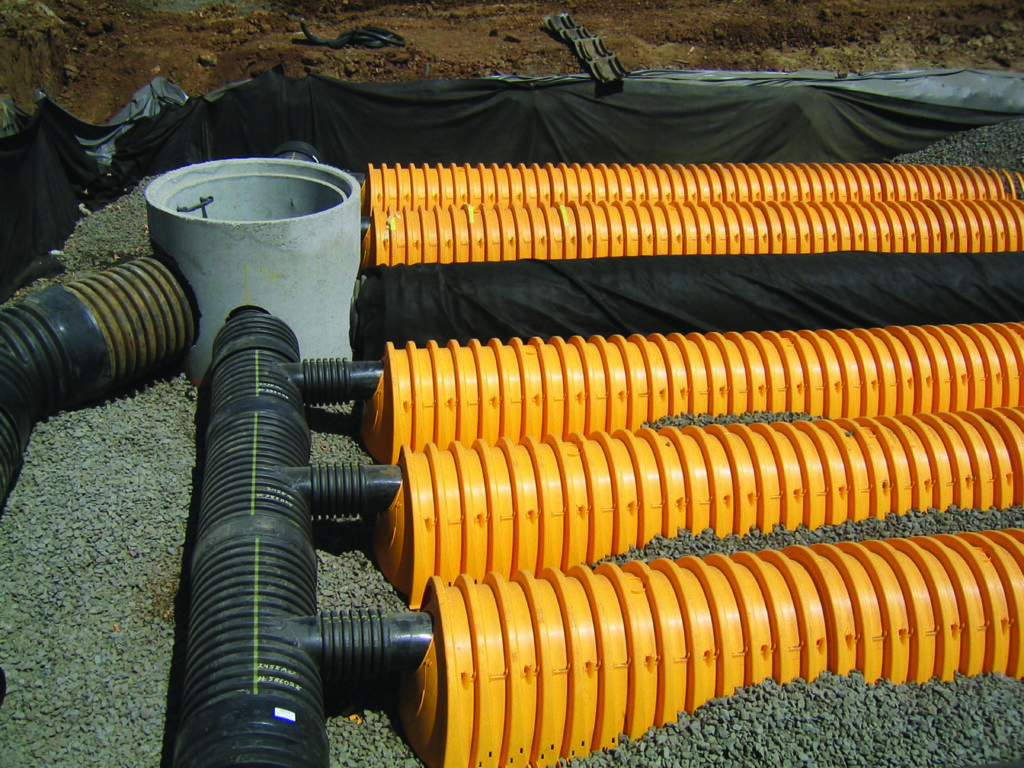
Stuart Crisp, UK Manager, Advanced Drainage Systems, looks at the range of proprietary attenuation solutions available for ‘grey’ Sustainable Drainage Systems (SuDS), offering flexibility and performance when vegetative approaches are not practical or sufficient.
Permeable paving
Among the most commonly used proprietary solutions is permeable block paving, which allows water to pass through joints between blocks, filtering through coarse sand and then granular fill beneath. This provides two stages of treatment – filtration and adsorption/biodegradation. It tends to require less excavation than below ground tanks, but regular maintenance is critical to prevent clogging of the joints, whilst care must be taken to ensure that the ‘wash water’ does not enter the system. Water companies rarely adopt permeable paving as it also serves as structural pavement and if used for infiltration, will not meet the criteria under the updated definition of a “sewer”.
Geocellular crates
Crate-based systems can provide high storage volume within a limited footprint and are relatively easy to install. However, they are prone to sediment build-up and often lack adequate upstream treatment; full sediment removal from the tank can be difficult. This can reduce flow rates and storage capacity over time. Not all crates meet current structural standards, and some adopters may not accept them. The SuDS Manual recommends upsizing storage volume of “difficult to clean” systems by 10% to account for sediment accumulation.
Large-diameter pipes
Used singly or manifolded in parallel, these are an established attenuation method. Typically made of concrete, steel or plastic, they were a “first generation” solution, but today’s proprietary attenuation systems tend to be more efficient in terms of storage volume to excavation volume and footprint to storage volume. This can make the installed cost of pipe-based attenuation systems less competitive. Also, some pipe material types may not meet adoption criteria.
Arch-shaped chambers
Innovative systems like arch-shaped chambers (e.g. StormTech) combine storage and treatment. Lightweight, modular and easy to install, they can be fitted around existing infrastructure and operate at shallow depths while supporting HGV loads. StormTech includes Isolator Row, a built-in treatment system that removes sediments and other pollutants– often eliminating the need for additional upstream treatment devices.
This brand of arches provides a total of four stages of water treatment: sedimentation and filtration in Isolator Row, followed by adsorption and biodegradation in the surrounding stone. It is compliant with the requirements set out in Design and Construction Guidance (DCG) for sewer adoption.
Green and grey
Vegetative SuDS (e.g. ponds, swales) can be effective where space is available and pollutant loads are low. But limiting designs to green features may compromise performance in certain situations. A hybrid approach – combining green and grey infrastructure may provide a lower cost, higher performing and lower environmental impact solution.
All SuDS systems require maintenance – natural ones included. Ponds need de-silting; vegetation must be managed; and litter removed. Similarly, proprietary systems must maintain hydraulic performance and treatment function. Substituting components purely to cut capital costs often risks long-term effectiveness.
With climate change is increasing extreme rainfall events, and the associated sediment and pollutant loads, designers need flexible tools. Grey and green SuDS, used in combination, can deliver technically, environmentally and economically sustainable solutions for the lifetime of a development.
Originally Published in New Civil Engineer November 2025 - Edited in March 2026
© Copyright 2026. All rights reserved | Privacy Policy